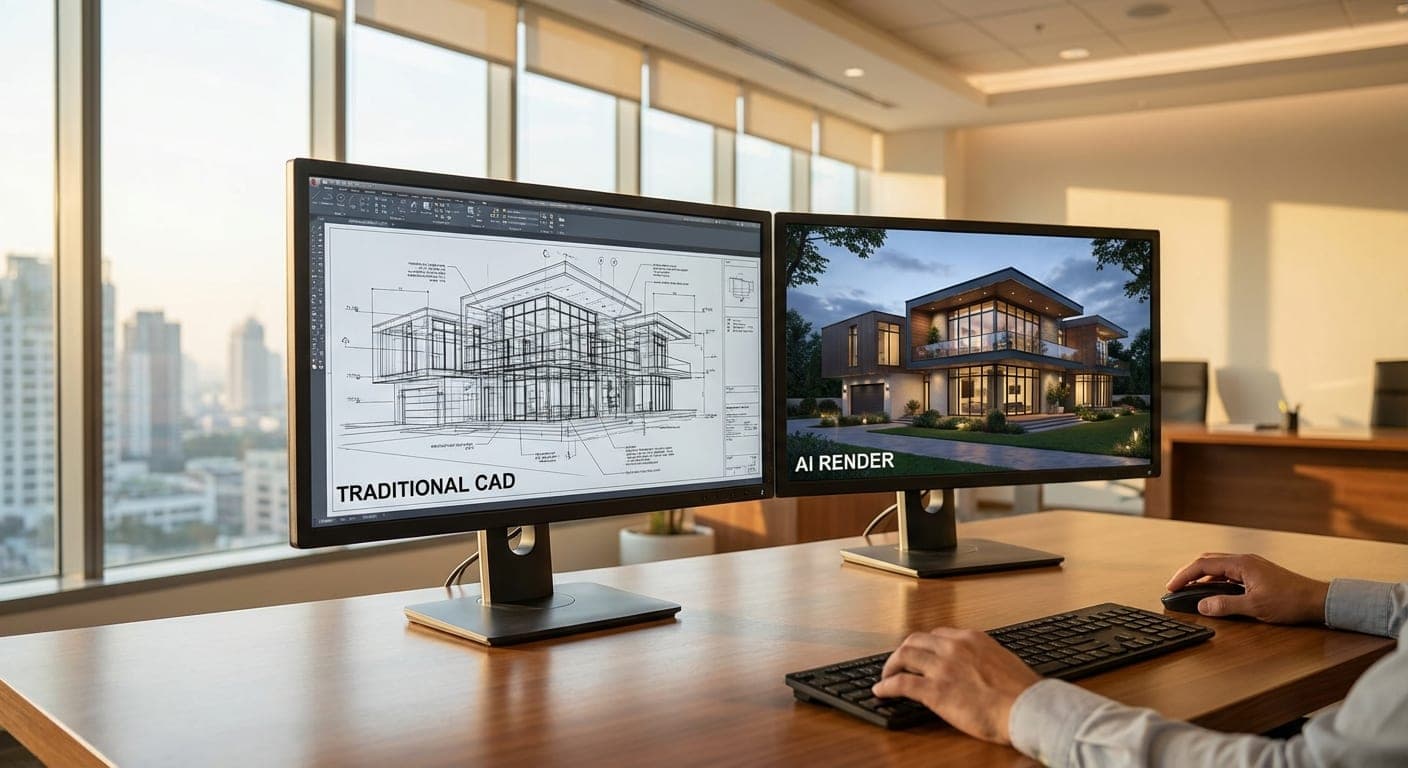
The Shifting Sands of Visualization: AI Renders vs. Traditional CAD
In the dynamic world of construction and contracting, clear visualization is paramount. It bridges the gap between concept and reality, helping clients understand proposals and teams execute plans flawlessly. For decades, Traditional Computer-Aided Design (CAD) has been the undisputed champion, providing the backbone for every blueprint, structural detail, and material takeoff. However, a new contender has entered the arena: AI-generated renders. This burgeoning technology promises stunning visuals at unprecedented speed, raising a crucial question for forward-thinking contractors: Which is right for you? Or perhaps, how can both serve your business?
Traditional CAD: The Unwavering Foundation
CAD software, encompassing tools like AutoCAD, Revit, and SketchUp Pro, has been the bedrock of architectural and engineering design for good reason. It’s a precision instrument, designed for meticulous detail and technical accuracy.
Strengths of Traditional CAD:
- Unmatched Precision: CAD delivers exact measurements, tolerances, and material specifications critical for structural integrity and fabrication. These are not merely pictures; they are data-rich models.
- Technical Detail & Documentation: Essential for permit applications, detailed construction drawings, shop drawings, and as a contractual basis. Every line, dimension, and annotation carries specific, actionable information.
- Industry Standard: CAD files are universally understood and collaborated upon across architects, engineers, subcontractors, and suppliers. It facilitates seamless information exchange (e.g., BIM workflows).
- Reliability & Control: Designers have absolute control over every element, ensuring compliance with building codes and project specifications.
- Complex Project Management: CAD, especially in BIM environments, allows for clash detection, quantity takeoffs, and precise planning for large, intricate projects.
Weaknesses of Traditional CAD:
- Time-Consuming for Photorealism: While CAD can produce high-quality renders, achieving true photorealism often requires specialized rendering engines, significant processing power, and substantial time investment from skilled professionals.
- Steep Learning Curve: Mastering advanced CAD software and rendering techniques requires extensive training and experience.
- Costly Software & Talent: Licensing fees for professional CAD software and the salaries for experienced CAD drafters/modelers represent a significant overhead.
AI Renders: The Future of Visual Communication?
AI rendering tools leverage artificial intelligence to generate photorealistic images from various inputs, including simple text prompts, rough sketches, or even basic 3D models. The technology is rapidly evolving, making sophisticated visualization more accessible than ever before.
Strengths of AI Renders:
- Blazing Speed: AI can generate multiple high-quality renders in minutes or seconds, a fraction of the time it takes with traditional methods.
- Cost-Efficiency: For initial concepts and marketing materials, AI can significantly reduce the need for expensive rendering software and specialized human labor.
- Stunning Photorealism & Aesthetics: AI excels at creating visually appealing, realistic images with sophisticated lighting, textures, and environments.
- Rapid Iteration & Conceptualization: Explore numerous design variations and aesthetic possibilities quickly, presenting clients with a wide array of options without extensive re-modeling.
- Accessibility: Many AI rendering platforms are user-friendly, allowing even non-CAD specialists to generate impressive visuals with minimal training.
Weaknesses of AI Renders:
- Lack of Technical Precision: AI renders are primarily aesthetic; they lack the underlying data, exact dimensions, and technical specifications required for construction. They are visuals, not blueprints.
- Potential for Inaccuracies ("Hallucinations"): AI can sometimes generate illogical details, architectural impossibilities, or misinterpret specific requests, requiring careful human oversight and correction.
- Limited Customization & Control: While impressive, AI often provides less granular control over every minute detail compared to traditional CAD, which is built for exact specification.
- Not for Fabrication or Contract Documents: AI renders cannot replace detailed drawings for manufacturing, assembly, or legal/contractual purposes.
- Data Security & IP Concerns: Depending on the platform, input data and generated outputs might have intellectual property or confidentiality implications.
Which is Right for You? A Practical Guide for Contractors
The choice isn't necessarily about replacing one with the other, but understanding where each tool shines in your project workflow.
Considerations:
- Project Phase: Are you in early conceptual design, detailed engineering, client presentation, or construction documentation?
- Purpose of the Visual: Is it for marketing, an internal design review, a subcontractor bid, or a permit application?
- Required Accuracy: Does it need to be technically exact, or is a realistic impression sufficient?
- Budget & Timeline: How much time and money can you allocate to visualization?
Practical Applications:
- For Marketing & Client Pitches (Pre-Contract): AI Renders are incredibly powerful. Use them to quickly generate stunning visual proposals, showcase different material palettes, or visualize exterior landscaping options. They captivate clients and secure projects faster.
- For Conceptual Design & Rapid Iteration: AI Renders can help you and your clients quickly visualize different layouts, styles, and finishes, iterating through ideas before committing to detailed CAD work.
- For Detailed Design, Engineering, & Sub-Trade Coordination: Traditional CAD (and BIM) is absolutely non-negotiable. This is where precise measurements, structural details, MEP layouts, and clash detection ensure constructability and safety.
- For Permitting, Legal, & Fabrication Documents: Stick with Traditional CAD. These documents demand absolute accuracy and adherence to industry standards, which AI cannot currently provide.
- The Hybrid Approach (The Sweet Spot): Many contractors are finding immense value in combining both. Use your existing CAD models as inputs for AI rendering tools. This allows you to generate photorealistic client presentations from technically accurate CAD files with incredible speed and flexibility. Imagine taking your precise Revit model and, with AI, instantly generating renders showing it at different times of day, with varying landscaping, or alternative cladding materials for a client review.
The Verdict: A Powerful Partnership, Not a Replacement
Ultimately, AI renders and Traditional CAD are not adversaries but complementary tools, each excelling in different stages of the construction lifecycle. AI is poised to revolutionize how we visualize, communicate, and win projects, bringing speed, aesthetic brilliance, and accessibility to the forefront. Traditional CAD, however, remains the bedrock of technical accuracy, detailed execution, and contractual integrity.
Clear Takeaways for Contractors:
- Embrace AI for Speed & Impact: Leverage AI renders for compelling marketing, winning client presentations, and rapid conceptual exploration.
- Rely on CAD for Precision & Execution: Maintain your CAD workflows for detailed design, engineering, construction documentation, and all aspects requiring absolute technical accuracy.
- Explore the Hybrid Advantage: Integrate AI tools into your existing CAD/BIM workflows to supercharge your visualization capabilities for client-facing materials, saving time and money without sacrificing technical precision where it counts.
- Stay Informed: The AI landscape is evolving rapidly. Continuously assess new tools and techniques to maintain a competitive edge.
By strategically integrating both AI renders and Traditional CAD into your operations, you can enhance client engagement, streamline design processes, and ultimately, build better projects more efficiently.