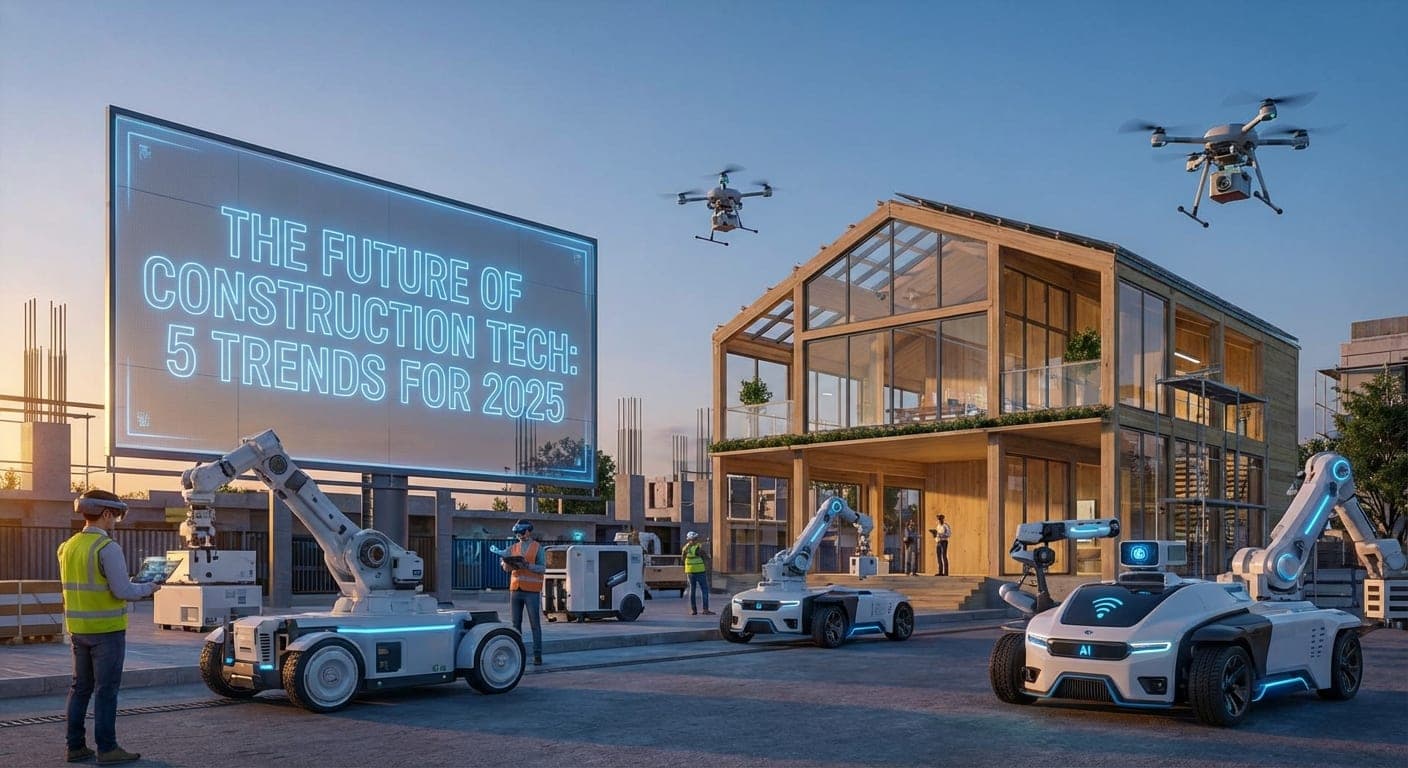
The Future is Now: 5 AI Trends Shaping Construction by 2025
The construction industry, often seen as a bastion of tradition, is undergoing a profound transformation. While the foundational principles of building remain, the tools and technologies we employ are evolving at an unprecedented pace. At the heart of this revolution is Artificial Intelligence (AI) – a powerful ally poised to redefine efficiency, safety, and profitability across every facet of your operations. By 2025, AI won't just be a buzzword; it will be an indispensable partner for forward-thinking contractors. Are you ready to harness its potential?
Here are five critical AI trends that will shape the future of construction in the very near future, complete with practical advice for integrating them into your business:
1. AI-Powered Project Management and Predictive Analytics
Managing complex construction projects involves countless variables: schedules, budgets, resources, weather, and unexpected delays. AI excels at processing this deluge of data, learning from past projects, and identifying patterns that human analysis might miss. By 2025, AI will move beyond simple data aggregation to offer highly accurate predictive insights.
- How it works: AI algorithms analyze historical project data, real-time site information, external factors (like weather forecasts or supply chain disruptions), and resource availability to forecast potential delays, cost overruns, and even optimal work sequences.
- Benefits for Contractors:
- Proactive Risk Management: Identify potential roadblocks before they materialize.
- Optimized Scheduling: Generate dynamic schedules that adapt to real-time conditions.
- Improved Resource Allocation: Ensure equipment and personnel are deployed most effectively.
- Enhanced Profitability: Reduce unexpected costs and improve project delivery times.
- Practical Advice:
- Start Small: Pilot AI-enabled project management software on a medium-sized project.
- Feed the Beast: Ensure consistent and accurate data input from all project stakeholders; AI is only as good as its data.
- Educate Your Team: Provide training on new AI tools to foster adoption and maximize their utility.
2. AI for Enhanced Site Safety and Quality Control
Safety is paramount on any construction site. AI is rapidly becoming a vigilant guardian, capable of monitoring vast areas for hazards, ensuring compliance, and even predicting potential incidents. Similarly, its ability to detect anomalies can drastically improve quality assurance.
- How it works: AI-powered computer vision systems analyze camera feeds to detect PPE (Personal Protective Equipment) compliance, identify unauthorized entry, spot unsafe behaviors, or flag potential falls. IoT sensors combined with AI can monitor equipment health or structural integrity.
- Benefits for Contractors:
- Real-time Hazard Detection: Immediately alert supervisors to safety violations or dangerous conditions.
- Reduced Incidents: Proactively address risks, leading to fewer accidents and injuries.
- Automated Compliance Checks: Ensure adherence to safety protocols without constant human oversight.
- Improved Quality Assurance: Detect defects or inconsistencies in real-time during construction phases.
- Practical Advice:
- Pilot AI Cameras: Implement AI-enabled cameras in high-risk zones or for specific compliance checks.
- Integrate with Existing Systems: Look for solutions that can integrate with your current safety management platforms.
- Focus on Training: Use AI insights to identify common safety gaps and target training efforts.
3. Generative AI and Intelligent Design Optimization
The pre-construction phase is ripe for AI innovation, particularly with the rise of generative AI. This technology can assist architects, engineers, and estimators in exploring design possibilities and optimizing constructability and cost.
- How it works: Generative AI algorithms can rapidly produce multiple design iterations based on specified parameters (e.g., budget, materials, structural constraints, energy efficiency). AI can also analyze BIM models to automate quantity take-offs, clash detection, and even suggest material alternatives.
- Benefits for Contractors:
- Faster Design Cycles: Significantly reduce the time spent on design exploration and refinement.
- Cost-Efficient Designs: Identify designs that optimize material use and construction methods.
- Improved Constructability: Proactively identify and resolve potential construction issues in the design phase.
- Enhanced Bid Accuracy: Automated take-offs and cost estimations lead to more competitive and accurate bids.
- Practical Advice:
- Embrace AI-Enabled BIM Tools: Invest in software that integrates AI for design optimization and analysis.
- Foster Collaboration: Encourage your design and estimation teams to work closely with AI tools, viewing them as powerful assistants.
- Start with Specific Use Cases: Apply AI to optimize specific components or systems within a project before full-scale adoption.
4. AI in Predictive Maintenance and Equipment Management
Your heavy equipment represents a significant investment. Unexpected breakdowns can lead to costly downtime and project delays. AI is transforming equipment management from reactive repairs to proactive, predictive maintenance.
- How it works: AI analyzes data from IoT sensors installed on machinery (e.g., vibration, temperature, fuel consumption, engine diagnostics). It learns normal operating patterns and identifies anomalies that signal impending failures, often days or weeks in advance.
- Benefits for Contractors:
- Maximized Uptime: Schedule maintenance during planned downtime, avoiding unexpected stoppages.
- Reduced Repair Costs: Address minor issues before they escalate into major, expensive failures.
- Extended Equipment Life: Proactive maintenance helps preserve the longevity of your assets.
- Optimized Maintenance Schedules: Move from fixed schedules to condition-based maintenance.
- Practical Advice:
- Invest in Smart Sensors: Equip your critical machinery with IoT sensors capable of collecting relevant data.
- Leverage Telematics Data: If your equipment already has telematics, explore AI platforms that can analyze this data.
- Integrate with CMMS: Connect AI-driven insights directly into your Computerized Maintenance Management System.
5. AI-Driven Robotics and Autonomous Systems
While fully autonomous construction sites might be a few years off, AI is already powering a new generation of construction robots and autonomous equipment that will be commonplace by 2025.
- How it works: AI enables robots to interpret their environment, execute complex tasks (e.g., bricklaying, welding, rebar tying), and navigate autonomously. AI also guides autonomous heavy equipment for tasks like earthmoving, grading, and surveying, often with greater precision than human operators.
- Benefits for Contractors:
- Increased Efficiency and Speed: Robots can perform repetitive tasks faster and with consistent quality.
- Enhanced Safety: Remove human workers from dangerous or physically demanding tasks.
- Improved Accuracy: AI-guided systems can achieve very high levels of precision.
- Labor Augmentation: Address labor shortages by automating certain aspects of work, freeing skilled workers for complex tasks.
- Practical Advice:
- Identify Repetitive Tasks: Look for processes on your sites that are suitable for automation (e.g., masonry, measuring, certain inspections).
- Explore Robotics-as-a-Service: Consider leasing robotic solutions initially to test their viability without a large upfront investment.
- Partner with Innovators: Collaborate with robotics companies to pilot solutions tailored to your specific needs.
Embrace the AI Advantage
The future of construction is intelligent, interconnected, and increasingly automated. AI isn't just about cutting-edge technology; it's about gaining a competitive edge, boosting your bottom line, and delivering safer, higher-quality projects. By proactively exploring and adopting these AI trends, you're not just preparing for 2025; you're building a more resilient, efficient, and profitable future for your construction business.
Don't be left behind. Start your AI journey today.